
Technical Specifications
| Specification | Details |
|---|---|
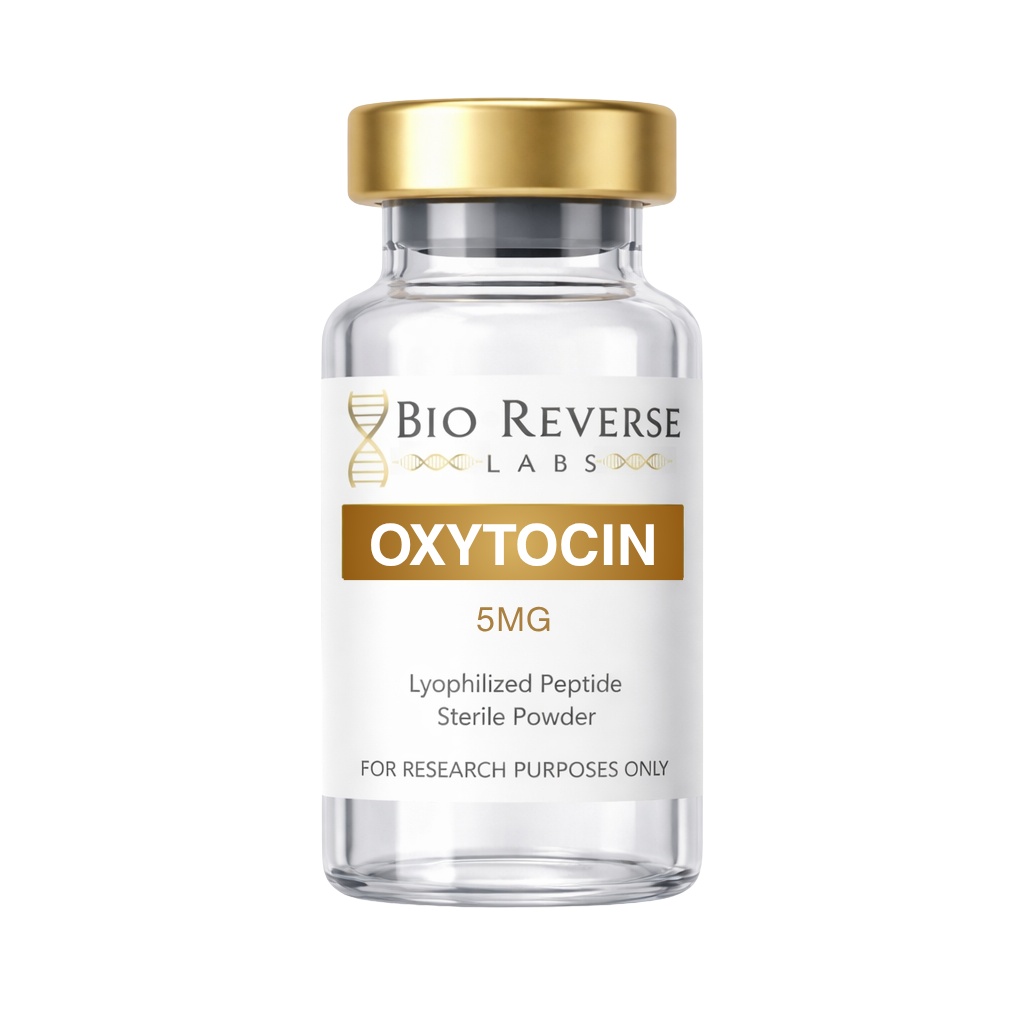
| Product Name | Oxytocin |
| Chemical Name | Oxytocin |
| Strength | 5mg |
| Molecular Formula | C₄₃H₆₆N₁₂O₁₂S₂ |
| Molecular Weight | ~1007.19 g/mol |
| CAS Number | 50-56-6 |
| Sequence | Cys-Tyr-Ile-Gln-Asn-Cys-Pro-Leu-Gly-NH₂ |
| Sequence Length | 9 amino acids |
| Structure | Cyclic nonapeptide with disulfide bridge |
| Purity | ≥98% |
| Form | Lyophilized Peptide |
| Classification | Synthetic Nonapeptide Hormone |
| Intended Use | Laboratory Research Only |
Product Overview
Oxytocin is a naturally occurring nonapeptide hormone and neuropeptide synthesized primarily in the hypothalamus and released from the posterior pituitary.
The peptide consists of nine amino acids and contains a characteristic disulfide bridge between two cysteine residues, creating a cyclic structure that is important to its molecular conformation.
Oxytocin has been extensively investigated in laboratory research involving neuropeptide signaling, receptor biology, smooth-muscle physiology, social and behavioral neuroscience, and endocrine signaling.
Its primary receptor, the oxytocin receptor (OXTR), is a G-protein-coupled receptor that mediates cellular responses to the peptide.
Mechanism of Action
Research has investigated oxytocin in relation to several biological mechanisms:
Oxytocin Receptor Signaling
Oxytocin interacts with the oxytocin receptor (OXTR), a G-protein-coupled receptor involved in intracellular calcium and signaling pathways.
Neuroendocrine Research
Oxytocin has been studied extensively as a neuroendocrine signaling molecule involved in communication between the hypothalamus, pituitary system, and peripheral tissues.
Smooth-Muscle Research
Experimental studies have investigated oxytocin receptor signaling in smooth-muscle tissues and associated cellular responses.
Social & Behavioral Research
Oxytocin is widely studied in neuroscience research examining social behavior, affiliative signaling, stress responses, and social cognition.
Cellular Signaling Research
Oxytocin provides a useful experimental model for studying peptide-receptor interactions and downstream intracellular signaling mechanisms.
Research Applications
Oxytocin may be investigated in laboratory settings involving:
- Oxytocin receptor research
- Neuropeptide signaling
- Neuroendocrine studies
- Social neuroscience
- Behavioral research
- Stress-response research
- Smooth-muscle physiology
- Cellular signaling studies
- G-protein-coupled receptor research
- Synthetic peptide research
Handling & Storage
- Store the lyophilized peptide according to the manufacturer’s recommended conditions.
- Protect from excessive heat, moisture, and direct sunlight.
- Keep the product sealed in its original packaging until required for laboratory research.
- Store at approximately −20°C when consistent with supplier specifications.
- Follow the applicable batch Certificate of Analysis for exact storage requirements.
- Minimize unnecessary temperature fluctuations.
- Avoid repeated freeze-thaw cycles where applicable.
- Protect the material from prolonged exposure to moisture and light.
Product Features
✓ Research Grade Quality
✓ ≥98% Purity
✓ Synthetic Nonapeptide
✓ 9-Amino-Acid Sequence
✓ Cyclic Peptide Structure
✓ Disulfide-Bonded Peptide
✓ Lyophilized for Stability
✓ Carefully Packaged
✓ Laboratory Research Use Only
Important Notice
This product is intended exclusively for laboratory research purposes.
It is not intended for human or veterinary use, administration, injection, consumption, diagnosis, treatment, cure, or prevention of any disease.
Oxytocin is a biologically active peptide hormone. This research-grade product is supplied for controlled laboratory investigation and should not be interpreted as a recommendation for unapproved human or veterinary applications.
The exact purity, molecular characterization, salt form, concentration, and analytical specifications should be verified against the applicable batch Certificate of Analysis (CoA).
By purchasing this product, the purchaser acknowledges that it will be handled only by qualified professionals in appropriate laboratory environments and used in accordance with applicable laws, regulations, and institutional protocols.
Frequently Asked Questions
What is oxytocin?
Oxytocin is a naturally occurring nine-amino-acid peptide hormone and neuropeptide that has been extensively studied in endocrine, neurological, reproductive, and behavioral research.
What is the sequence of oxytocin?
The commonly reported sequence is:
Cys-Tyr-Ile-Gln-Asn-Cys-Pro-Leu-Gly-NH₂
The two cysteine residues form an intramolecular disulfide bridge.
How many amino acids does oxytocin contain?
Oxytocin is a nonapeptide, meaning it contains nine amino-acid residues.
What is the molecular weight of oxytocin?
The molecular weight of oxytocin is approximately 1007.19 g/mol.
What receptor does oxytocin interact with?
Oxytocin primarily interacts with the oxytocin receptor (OXTR), a G-protein-coupled receptor.
What is oxytocin researched for?
Oxytocin is investigated in research involving neuropeptide signaling, neuroendocrine biology, social neuroscience, behavioral research, smooth-muscle physiology, receptor signaling, and cellular communication.
What form does oxytocin come in?
Research-grade oxytocin may be supplied as a lyophilized (freeze-dried) synthetic peptide.
What is the purity of oxytocin?
This product is specified at a minimum purity of ≥98%, subject to the applicable batch Certificate of Analysis.
Is oxytocin intended for human use?
No. This research-grade product is supplied strictly for laboratory research purposes and is not intended for human or veterinary use.
How should oxytocin be stored?
The lyophilized peptide should be protected from heat, moisture, and direct sunlight and stored according to the manufacturer’s recommended conditions. Always refer to the batch-specific Certificate of Analysis for exact storage requirements.
Reviews
There are no reviews yet.