
Technical Specifications
| Specification | Details |
|---|---|
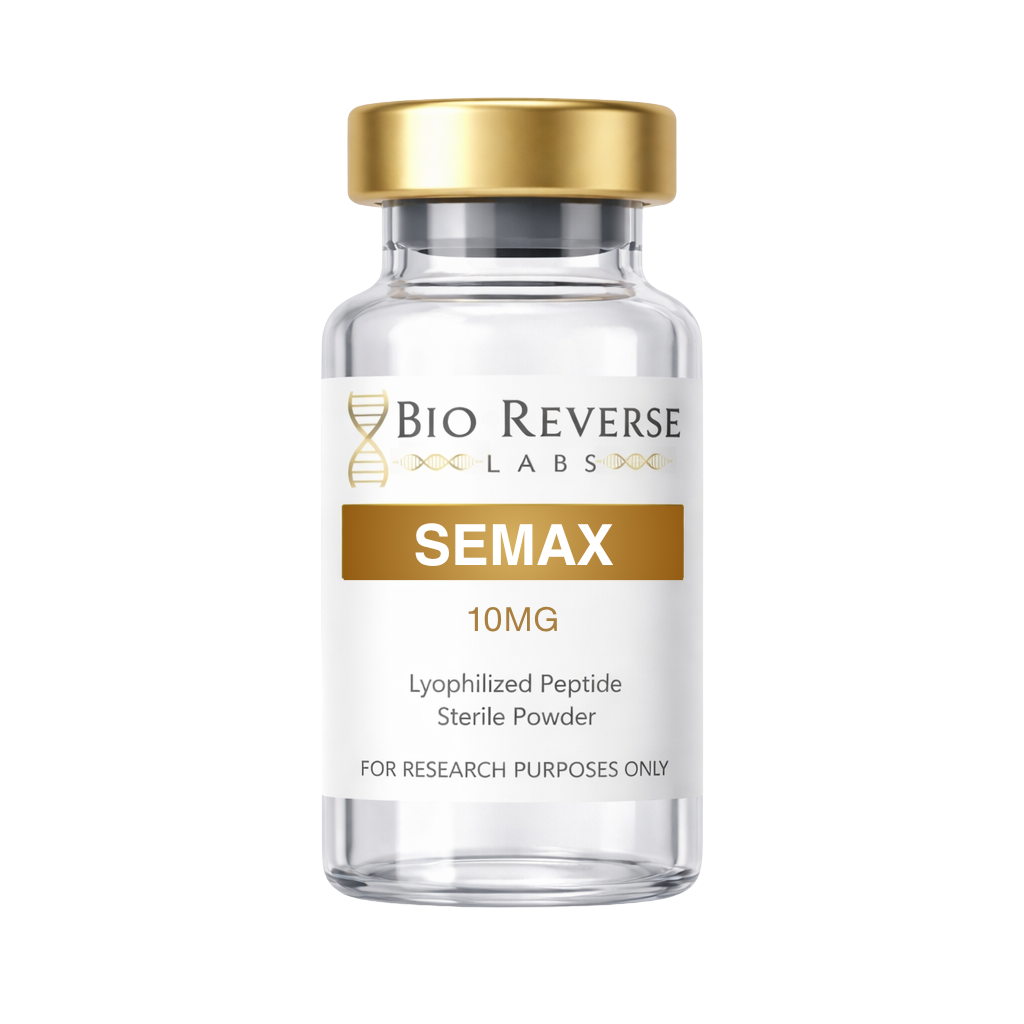
| Product Name | Semax |
| Molecular Formula | C₃₇H₅₁N₉O₁₀S |
| Molecular Weight | ~869.9 g/mol |
| Sequence | Met-Glu-His-Phe-Pro-Gly-Pro |
| Purity | ≥98% |
| Form | Lyophilized Peptide |
| Synonyms | ACTH(4–7) Analog, Heptapeptide Semax |
Product Overview
Semax is a synthetic heptapeptide derived from the ACTH(4–10) fragment and modified to improve stability against enzymatic degradation. It has been widely investigated in laboratory research for its potential neuromodulatory and neurotrophic properties.
Its unique structure allows researchers to explore mechanisms related to neuronal signaling, cognitive function, and adaptive stress responses without the hormonal activity typically associated with adrenocorticotropic hormone (ACTH).
Mechanism of Action
Preclinical and laboratory studies have investigated Semax for its potential involvement in several biological pathways, including:
Neurotrophic Activity
Research has explored Semax for its influence on Brain-Derived Neurotrophic Factor (BDNF) and Nerve Growth Factor (NGF), both of which play important roles in neuronal development and plasticity.
Neurotransmitter Regulation
Semax has been studied for its interactions with dopaminergic and serotonergic signaling pathways involved in learning, memory, and behavioral research.
Oxidative Stress Research
Experimental models have evaluated Semax for its potential role in cellular responses to oxidative stress within neural tissues.
Immune-Neurological Research
Studies have investigated interactions between inflammatory signaling pathways and neurological function.
Cerebral Function Research
Research models have explored Semax in relation to neuronal communication, cerebral circulation, and synaptic activity.
Research Applications
Semax is commonly investigated in laboratory settings involving:
- Cognitive and learning research
- Memory and attention studies
- Neuroplasticity research
- Experimental models of neurodegeneration
- Cerebral ischemia and neuroprotection studies
- Stress response research
- Neuroinflammation research
- Visual and sensory system research
Handling & Storage
- Store lyophilized product at −20°C in a cool, dry environment.
- Protect from heat, moisture, and direct sunlight.
- Reconstitute using sterile laboratory-grade water or an appropriate research buffer.
- Once reconstituted, store at 2–8°C and use according to established laboratory protocols.
- Avoid repeated freeze–thaw cycles.
Product Features
✓ Research Grade Quality
✓ ≥98% Purity
✓ Lyophilized for Stability
✓ Laboratory Research Use Only
✓ Carefully Packaged
Important Notice
This product is intended exclusively for laboratory research purposes.
It is not intended for human or veterinary use, nor is it intended for the diagnosis, treatment, cure, or prevention of any disease.
By purchasing this product, the purchaser acknowledges that it will be handled only by qualified professionals in controlled laboratory environments and used in accordance with all applicable laws and regulations.
Frequently Asked Questions
Is Semax intended for human use?
No. This product is supplied strictly for laboratory research purposes and is not intended for human or veterinary use.
What form does this product come in?
Semax is supplied as a lyophilized (freeze-dried) peptide for laboratory research.
What is the purity of this product?
This product is manufactured to a minimum purity specification of ≥98%.
How should Semax be stored?
Store the lyophilized peptide at −20°C. After reconstitution, store refrigerated at 2–8°C and avoid repeated freeze–thaw cycles.
Reviews
There are no reviews yet.