
Technical Specifications
| Specification | Details |
|---|---|
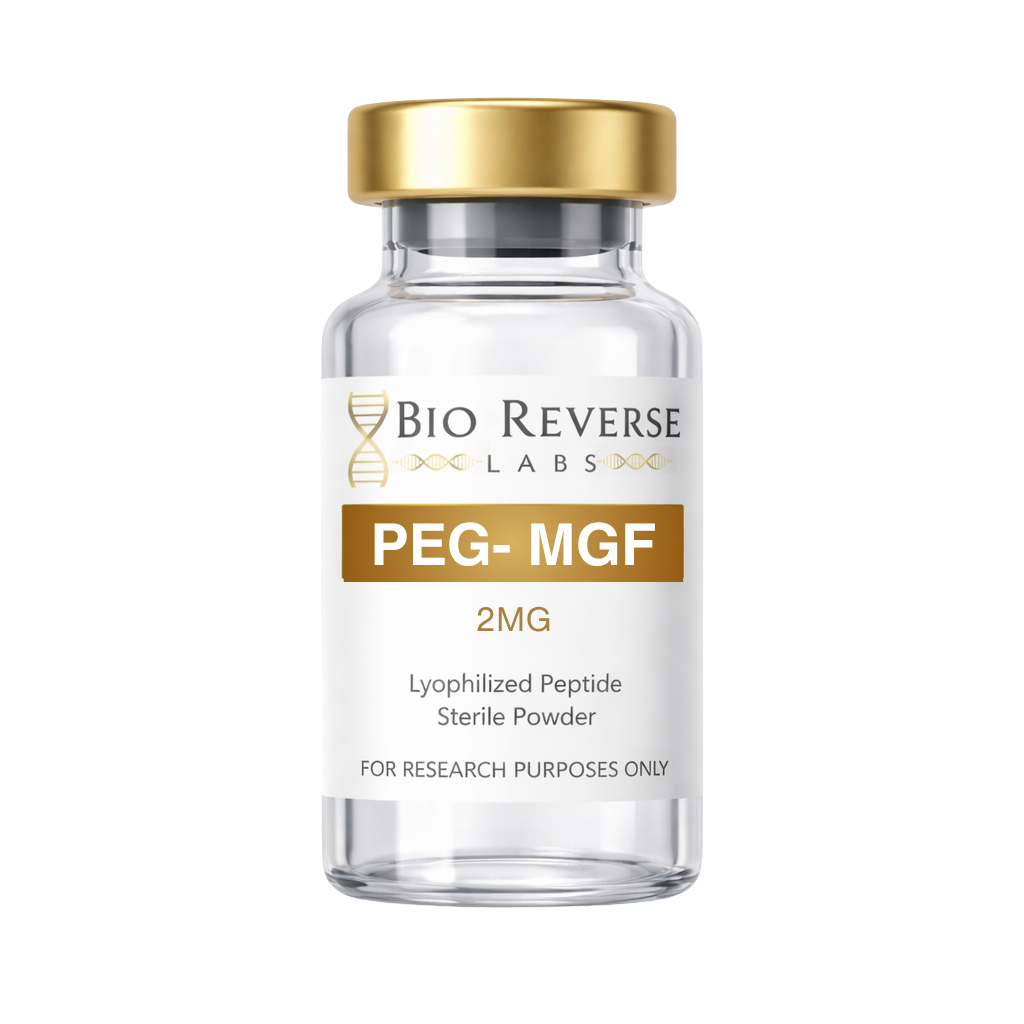
| Product Name | PEG-MGF |
| Strength | 2 mg |
| Chemical Name | Pegylated Mechano Growth Factor |
| Synonyms | PEG-MGF, Pegylated MGF, Pegylated Mechano Growth Factor |
| Base Peptide | Mechano Growth Factor (MGF) E-domain |
| Base Peptide Sequence | Tyr-Gln-Pro-Pro-Ser-Thr-Asn-Lys-Asn-Thr-Lys-Ser-Gln-Arg-Arg-Lys-Gly-Ser-Thr-Phe-Glu-Glu-Arg-Lys |
| Base Peptide Molecular Weight | ~2,867.2 g/mol |
| PEG Component | Polyethylene Glycol (PEG) conjugate |
| Purity | ≥98% |
| Form | Lyophilized Peptide |
| Classification | PEGylated Growth-Factor Peptide |
| Intended Use | Laboratory Research Only |
Product Overview
PEG-MGF, or Pegylated Mechano Growth Factor, is a modified form of the MGF peptide associated with the IGF-1 gene and investigated in experimental research involving muscle and cellular signaling.
PEGylation involves the covalent attachment of a polyethylene glycol chain to the peptide. This modification is designed to alter the peptide’s physicochemical properties and improve resistance to rapid enzymatic degradation compared with the unmodified peptide.
The MGF E-domain sequence commonly used in research is a 24-amino-acid peptide sequence associated with the IGF-1 Ec splice variant. PEG-MGF has been investigated as a research tool for studying peptide stability, growth-factor-related signaling, cellular responses, and muscle biology.
Because the PEG component can vary in molecular size, the molecular weight of the complete PEG-MGF conjugate should be confirmed using the manufacturer’s batch-specific analytical documentation.
Mechanism of Action
Experimental research has investigated PEG-MGF in relation to several biological pathways:
Growth-Factor Signaling Research
MGF is associated with the IGF-1 signaling system, making PEG-MGF a research tool for investigating pathways involved in cellular growth, differentiation, and tissue responses.
Muscle Biology Research
Experimental studies have investigated MGF-related signaling in models of muscle adaptation, satellite-cell activity, and skeletal-muscle biology.
Cellular Signaling Research
PEG-MGF can be studied in experimental systems examining growth-factor-mediated cellular signaling and peptide-receptor interactions.
Peptide Stability Research
The PEG modification provides a useful model for studying how polymer conjugation affects peptide stability, degradation, and molecular behavior.
Structure-Activity Research
PEG-MGF allows researchers to investigate how modification of the MGF peptide affects its physicochemical and biological characteristics.
Research Applications
PEG-MGF may be investigated in laboratory settings involving:
- Growth-factor signaling research
- Skeletal-muscle biology
- Satellite-cell research
- Cellular growth and differentiation studies
- Peptide stability research
- PEGylation research
- Protein and peptide pharmacology
- IGF-related signaling studies
- Molecular interaction research
- Synthetic peptide research
Handling & Storage
- Store the lyophilized peptide according to the manufacturer’s recommended conditions.
- Protect from excessive heat, moisture, and direct sunlight.
- Keep the product sealed in its original packaging until required for laboratory research.
- Follow the batch-specific Certificate of Analysis for exact storage requirements.
- Minimize unnecessary exposure to temperature fluctuations.
- Avoid repeated freeze-thaw cycles where applicable.
- Any reconstitution should be performed using appropriate laboratory procedures and materials.
Product Features
✓ Research Grade Quality
✓ 2mg Lyophilized Peptide
✓ ≥98% Purity
✓ PEGylated Peptide
✓ MGF E-Domain Based
✓ Carefully Packaged
✓ Laboratory Research Use Only
Important Notice
This product is intended exclusively for laboratory research purposes.
It is not intended for human or veterinary use, administration, injection, consumption, diagnosis, treatment, cure, or prevention of any disease.
PEG-MGF is an experimental research compound. Its safety, efficacy, pharmacokinetics, and potential therapeutic applications have not been established for human use.
The molecular weight of the complete PEG-MGF conjugate can vary according to the PEG component and conjugation specification. The applicable Certificate of Analysis (CoA) should therefore be used as the definitive source for batch-specific molecular characterization.
By purchasing this product, the purchaser acknowledges that it will be handled only by qualified professionals in appropriate laboratory environments and used in accordance with applicable laws, regulations, and institutional protocols.
Frequently Asked Questions
What is PEG-MGF?
PEG-MGF is a PEGylated form of Mechano Growth Factor (MGF), a peptide associated with the IGF-1 Ec splice variant and investigated in experimental growth-factor and muscle biology research.
What does PEG-MGF contain?
PEG-MGF consists of an MGF-derived peptide component covalently associated with a polyethylene glycol (PEG) chain. The exact PEG size and conjugation characteristics depend on the specific product formulation.
What is the molecular weight of PEG-MGF?
The commonly reported molecular weight of the unmodified MGF peptide component is approximately 2,867.2 g/mol. The complete PEG-MGF conjugate has a higher molecular weight that depends on the PEG component. Some supplier documentation reports approximately 8,637.7 g/mol for a specific PEG-MGF preparation.
What is the sequence of the MGF component?
The commonly reported MGF E-domain sequence is:
Tyr-Gln-Pro-Pro-Ser-Thr-Asn-Lys-Asn-Thr-Lys-Ser-Gln-Arg-Arg-Lys-Gly-Ser-Thr-Phe-Glu-Glu-Arg-Lys
What is PEGylation?
PEGylation is the process of covalently attaching a polyethylene glycol polymer to a peptide or protein. In research, PEGylation is investigated for its ability to modify stability, molecular size, solubility, and degradation characteristics.
What is PEG-MGF researched for?
PEG-MGF may be investigated in growth-factor signaling, muscle biology, cellular signaling, peptide stability, PEGylation, and IGF-related research.
Is PEG-MGF intended for human use?
No. This product is supplied strictly for laboratory research purposes and is not intended for human or veterinary use.
How should PEG-MGF be stored?
The lyophilized peptide should be protected from heat, moisture, and direct sunlight and stored according to the manufacturer’s recommended conditions. Always refer to the batch-specific Certificate of Analysis for exact storage requirements.
Reviews
There are no reviews yet.