
Technical Specifications
| Specification | Details |
|---|---|
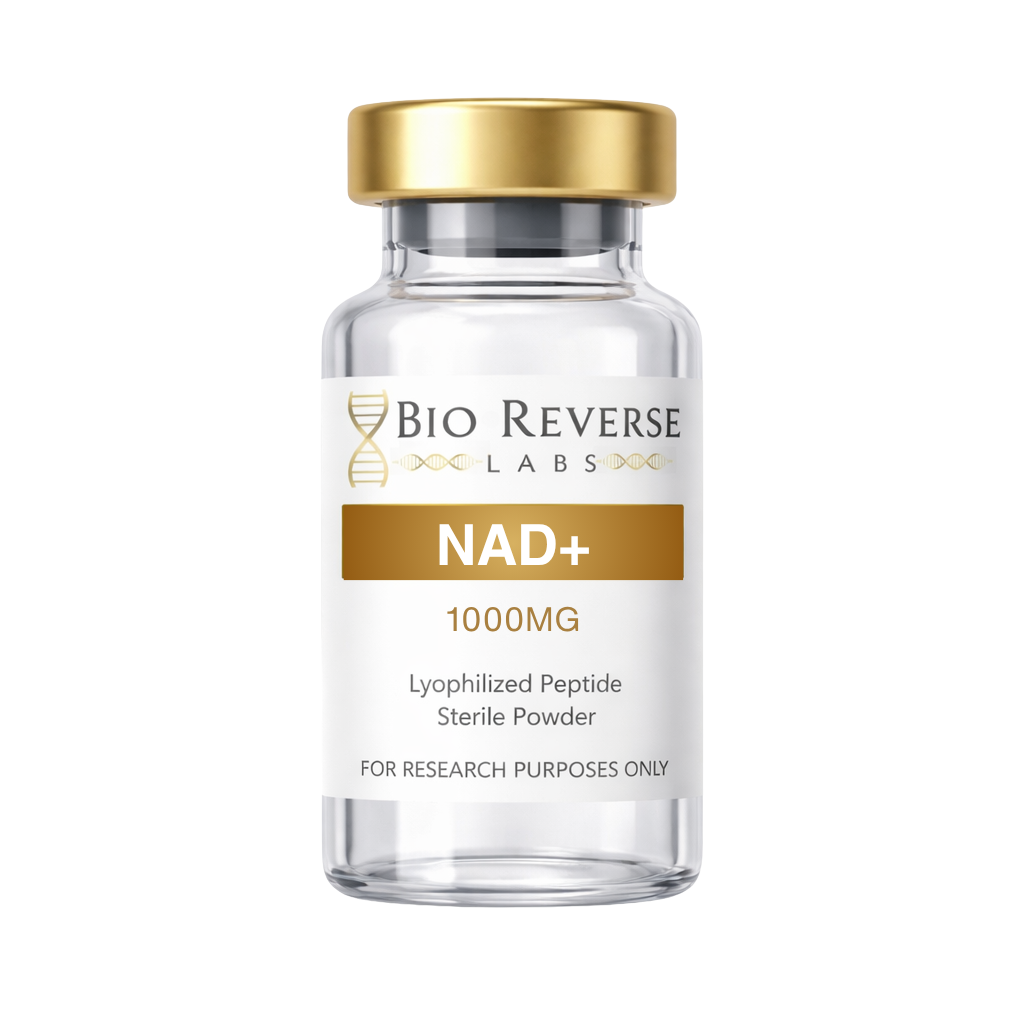
| Product Name | NAD+ |
| Chemical Name | Nicotinamide Adenine Dinucleotide, Oxidized Form |
| Strength | 1000 mg |
| Molecular Formula | C₂₁H₂₇N₇O₁₄P₂ |
| Molecular Weight | ~663.43 g/mol |
| CAS Number | 53-84-9 |
| Purity | ≥98% |
| Form | Research Compound / Powder |
| Classification | Dinucleotide Coenzyme |
| Oxidation State | Oxidized NAD+ |
| Intended Use | Laboratory Research Only |
Product Overview
NAD+, or nicotinamide adenine dinucleotide, is a naturally occurring cellular coenzyme involved in fundamental biochemical processes including energy metabolism and redox reactions.
NAD+ functions as an electron acceptor and participates in the reversible conversion between its oxidized form (NAD+) and reduced form (NADH).
Laboratory research has investigated NAD+-dependent pathways in areas including mitochondrial metabolism, cellular energy production, redox biology, DNA repair, and metabolic signaling.
Mechanism of Action
Research has investigated NAD+ in relation to several important cellular mechanisms:
Redox Reactions
NAD+ participates in numerous enzymatic electron-transfer reactions, cycling between NAD+ and NADH.
Cellular Energy Metabolism
NAD+-dependent enzymes contribute to metabolic pathways involved in cellular energy production.
Mitochondrial Research
The NAD+/NADH ratio is an important area of investigation in mitochondrial function, cellular respiration, and bioenergetics.
Sirtuin-Related Research
NAD+ serves as a required co-substrate for sirtuin enzymes, making NAD+-dependent signaling an important area of research involving cellular metabolism and gene regulation.
DNA Repair Research
NAD+ is utilized by enzymes involved in cellular stress responses and DNA-repair processes, including poly(ADP-ribose) polymerase (PARP) activity.
Research Applications
NAD+ may be investigated in laboratory settings involving:
- Cellular energy metabolism
- Redox biology
- NAD+/NADH research
- Mitochondrial function
- Cellular bioenergetics
- Sirtuin biology
- DNA-repair research
- Metabolic signaling
- Oxidative-stress research
- Enzyme activity studies
- Cellular aging research
- Coenzyme and metabolic pathway research
Handling & Storage
- Store NAD+ according to the manufacturer’s recommended conditions.
- Protect from excessive heat, moisture, and direct sunlight.
- Keep the product tightly sealed when not in use.
- Minimize prolonged exposure to air, moisture, and light.
- Follow the applicable batch Certificate of Analysis for exact storage requirements.
- Handle using appropriate laboratory procedures and protective equipment.
- Avoid unnecessary temperature fluctuations.
Product Features
✓ Research Grade Quality
✓ 1000mg Quantity
✓ ≥98% Purity
✓ NAD+ Coenzyme
✓ Oxidized Nicotinamide Adenine Dinucleotide
✓ Laboratory Research Grade
✓ Carefully Packaged
✓ Laboratory Research Use Only
Important Notice
This product is intended exclusively for laboratory research purposes.
It is not intended for human or veterinary use, administration, injection, consumption, diagnosis, treatment, cure, or prevention of any disease.
NAD+ is an experimental research material when supplied in this format. Research findings involving NAD+-dependent pathways should not be interpreted as established evidence of clinical efficacy or safety for any particular human application.
The exact purity, formulation, hydration state, salt form, and analytical specifications should be verified against the applicable batch Certificate of Analysis (CoA).
By purchasing this product, the purchaser acknowledges that it will be handled only by qualified professionals in appropriate laboratory environments and used in accordance with applicable laws, regulations, and institutional protocols.
Frequently Asked Questions
What is NAD+?
NAD+ stands for nicotinamide adenine dinucleotide and is the oxidized form of this important cellular coenzyme.
Is NAD+ a peptide?
No. NAD+ is a dinucleotide coenzyme, not a peptide or protein.
What is the molecular formula of NAD+?
The molecular formula of NAD+ is C₂₁H₂₇N₇O₁₄P₂.
What is the molecular weight of NAD+?
NAD+ has a molecular weight of approximately 663.43 g/mol.
What is NAD+ researched for?
NAD+ is investigated in research involving cellular energy metabolism, redox reactions, mitochondrial biology, sirtuin activity, DNA-repair pathways, oxidative stress, and metabolic signaling.
What is the difference between NAD+ and NADH?
NAD+ is the oxidized form, while NADH is the reduced form. Cells continuously cycle between these forms during many metabolic and redox reactions.
What form does NAD+ 1000mg come in?
NAD+ 1000mg is supplied as a research-grade compound rather than a peptide.
What is the purity of NAD+?
This product is specified at a minimum purity of ≥98%, subject to the applicable batch Certificate of Analysis.
Is NAD+ intended for human use?
No. This product is supplied strictly for laboratory research purposes and is not intended for human or veterinary use.
How should NAD+ be stored?
NAD+ should be protected from excessive heat, moisture, light, and prolonged exposure to air and stored according to the manufacturer’s recommended conditions. Always refer to the batch-specific Certificate of Analysis for exact storage requirements.
Reviews
There are no reviews yet.